|
ETHICAL TRAVEL:
The Holidaymaker & The Travel Industry.
The Planet is a diverse and fragile organism. Travel is a great unifier and educator, however, it is also the greatest threat to the Planet's social and biological balance. 21st century travellers now have the opportunity to reach into the furthest corners of the globe, and experience what diverse cultures and terrains have to offer. It is precisely because of this ability, it is no longer acceptable to simply 'click and go'.
Todays holidaymaker should research, examine and make moral decisions as to whether they should go to a particular destination. Questions now arise, what is the pollution effect of my journey, can the local economy support my social footprint on their landscape, how much of my money goes to the local economy, what investment is being carried out by governments, local councils or Tour Operators; how many hours does my chambermaid or waiter have to work, do they have union represention, what freedoms exist for local people, does a government hold a record for human rights abuses?
This may seem an onerous responsibility to place on an ordinary holidaymaker, but these are questions that cut to the heart of our own society; why should anyone abandon one morality for another? We suggest that by answering these questions, the holidaymaker will hopefully achieve a holiday that will be richer and more enjoyable, than a holiday that simply invites you to 'click and go'.
We would be interested to hear from any holidaymaker who has experience of such ethical travel issues, and with their permission, use their experience to educate a wider audience through this website.
Below we have listed organisations which are at the forefront of Ethical Travel or Moral Issues. We would ask you to note that these organisations are not linked to HolidayTravelWatch, and that we do not contribute nor are responsible for the content of their websites. We would also ask you to note that any reference to travel companies are not endorsed by us, such endorsements are the responsibility of the relevant organisation. We would ask you to note the content of our legal notice.
| Tourism Concern is an Organisation dedicated to the promotion of Ethical Travel, who develop projects to demonstrate that there is another way to organise travel for the benefit of local communities. We recommend a visit to this website which contains a wonderful and humbling photographic record and comments from people within the travel industry. It also contains useful information on workers rights, water and development issues. Their travel code is simple; Learn about the Country you are visiting, Think about the cost of your holiday, Open your mind to new cultures and traditions, minimise your environmental impact, Use guidebooks to broaden you knowledge, use photography with respect. To visit their website click here... |
|
| Amnesty International is a global organisation which highlights the threats to human rights, through examples of torture, ill treatment, false arrest, false imprisonment; often leading to long prison sentences for offences, which would be classed as normal every day activity in the UK. The visitor to the UK website may be surprised to see that many popular destinations are subject to the scrutiny of Amnesty International. To visit their website click here... |
|
| Redress is a UK based Organisation that campaigns against the use of torture and abuse of human rights. Full details of their findings and campaigns can be found on their website. The organisation provides a list of countries breaching human rights law, many of which are popular destinations for UK holidaymakers. To visit their website click here... |
|
| ClimateCare is an organisation that helps you to calculate your carbon footprint, through the use of their CO2 calculator. You can then offset the damage your travel causes, by paying a premium which is then used in climate development projects. You can visit their website by clicking here... |
|
| The Carbon Neutral Company invite you to calculate your flight emissions and then 'neutralise' them through international projects which save exactly the same amount of carbon dioxide. You can visit their website by clicking here... |
|
| The Earthwatch Institute is "an international environmental charity which is committed to conserving the diversity and integrity of life on earth to meet the needs of current and future generations". Its mission is to promote scientific and educational research through various projects, thus promoting a sustainable environment. You can view their website by clicking here... |
|
| We recently received a call for help from a holidaymaker who purchased a diamond in Turkey. The Holidaymaker paid over £2,500.00 for his diamond and was promised documentation to prove its authenticity. The documentation was not provided to him before he returned to the UK, and subsequent calls and letter's have produced no further contact from the 'diamond seller. The holidaymaker became concerned and took his diamond to several reputable dealers. None of the dealers would accept the diamond for sale, and all advised him that he may have inadvertently purchased a 'blood diamond' or 'conflict diamond'. At this time the stone is worthless and he has lost a great deal of money. When we explained the nature of these diamonds, the holidaymaker was naturally distraught. HolidayTravelWatch could only refer this holidaymaker to the trade bodies of the diamond industry for help, and offer sympathy for his predicament. 'Blood Diamonds' or 'Conflict Diamonds' are diamonds that do not pass through the recognised authentication processes, and the income from their sale, are used to buy arms and spread misery in countries where conflict exists. Holidaymakers should take great care when tempted to buy diamonds abroad, before you buy, ensure that you see the documentation before you part with any money. Use the links in this section to obtain further advices before you buy. This link directs you to The United Nations and the background information on this appalling industry, click here for further information. This link directs you to DiamondFacts and the World Diamond Council, click here for further information. |
The issues of Ethical and Moral Travel must however be jointly considered with the Travel Industry. Is is right that the onus of responsibility be placed entirely on the Holidaymaker? Is it just about planting trees? We think not! Recently we have seen some tour companies placing an 'eco' charge on their customers, we think to satisfy the current soundbite. However, we also have to give credit to this first tentative step, a step that leads to a greater corporate ethic within the early years of the 21st century.
We recently had the privilege of meeting with a young Gambian who explained his own country's concern with regard to the operation of 'bulk' European Tourism. His complaint surrounded the fact that large tour companies were bringing tourists to the Gambia, but effectively keeping them captive from the local community. This created an economic model whereby a large proportion of the money earned from the holidaymaker went straight to the tour company, not into the local economy. He cited the fact that many local artisans were prevented from entering hotels to sell their wares. The hotels would buy their products for a very low price, and then sell the same products at a much inflated price to the 'captive' holidaymakers. The artisan would have to produce more work, so that he could receive the kind of return he could get if he were able to sell directly to the holidaymakers. Other complaints included scaring holidaymakers from contact with local people, thereby preventing the creation of a true holiday experience, and a benefit to the local economy.
In other recent stories, we have heard of the impact of hotel complex creation on local water supplies, or simply the lack of use of local food products or services, with tour companies importing such items from outside and island or country.
HolidayTravelWatch has commented extensively on the issue of travel safety. We agree that local economies should not suffer the after effects of a natural or man made disaster, but we query, why send people into areas where either events can be predicted with a now greater certainty, or where through a common sense analysis, such matters of safety can be reasonably determined. The examples here relate to hurricane (or extreme weather events) or tourist terrorism. We have much experience in dealing with the effects of hurricane's and terror situations. In the case of extreme weather events, we simply say, that these are events that are predictable, and therefore a more mature and developed response to holidaymaker safety MUST be adopted.
In cases where terrorism is a threat, we simply ask why do we send people to these potential risk areas. We recently dealt with a Nile River Cruise complaint, which had the usual range of complaints. However, what was more disturbing was the fact that when this cruise boat had pulled into a mooring on the Nile, the boat was joined by up to 12 men with machine guns. They prevented holidaymakers from walking further than 50m from the boat. No explanation was given either by the representative nor by the brochure from where these holidays were booked. The holidaymakers were very angry that they had not been warned about the potential threat to their lives, if there was no threat, why so many with machine guns they asked?
HolidayTravelWatch recently had discussions with senior members of the Travel Industry, and a healthy debate ensued on the use of force majeure in holiday contracts. Our argument was simple, using FCO advices as the basis of whether you send someone to a particular country, did not end their responsibility toward the holidaymaker or for that matter to the people in the countries that rely on that holidaymaker. We considered that if individuals or this organisation can identify risk factors, then they as corporately responsible companies should also be able to identify those factors and add to the basic FCO advices.
We have commented previously, that those holidaymakers who are trapped or involved in weather or terrorist events, often feel great anger toward the tour company, and many, rightly or wrongly, to that particular country. Hardly an advertisement for sustainable tourism! If the holiday experience is turned into a dangerous shambles, what motivation then exists for that holidaymaker to return to that country?
The issue is quite simple, it is an issue of respect. Respect for the holidaymaker and the country in which business is done. It is not a radical idea, but an idea that should now be firmly routed in corporate life in the 21st century.
We have gathered together some of our own articles and other articles of interest which should provoke further thought for the intending holidaymaker:
|
produced an article entitled - Behind the Veile in the Maldives. It discusses the impact of tourism on the islands, and how local are being by-passed by the Travel Industry. The article contends that this is having an effect upon local life, and leading to political and religious difficuties, the challenge being to bring back a balance which truely helps local economy and social life in the islands. Read more... |
|
|
|
|
|
|
|
- This is an article which questions the ethic of travel companies during the summer of 2005. It concludes on the urgent need for a new corporate approach in the 21st century - The Summer of 2005 - 11.9.05.doc
|
|
- In this article we try to calculate the cost of returning holiday illnesses to the UK. However, we also suggest that the shocking result of this enquiry also raises questions on how the travel industry deals with hoteliers and staff. The article suggests that if the UK tackles the economic burden of returning holidaymakers illnesses, this would have the benefit of fairer dealings for workers and hoteliers within the travel industry, and not entirely for the benefit of shareholders - High Cost of Foreign Holidays Exposed - 26.10.06.pdf
|
|
|
 |
|
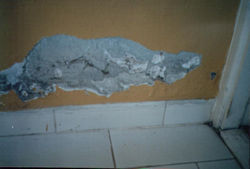
Broken plaster in hotel room |
|
 |
|
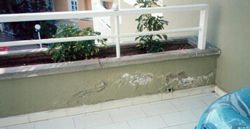
Poorly maintained hotel balcony |
|
 |
|
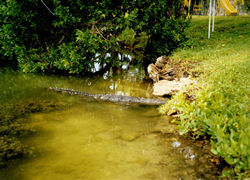
Alligator basking near hotel childrens playground |
|
 |
|
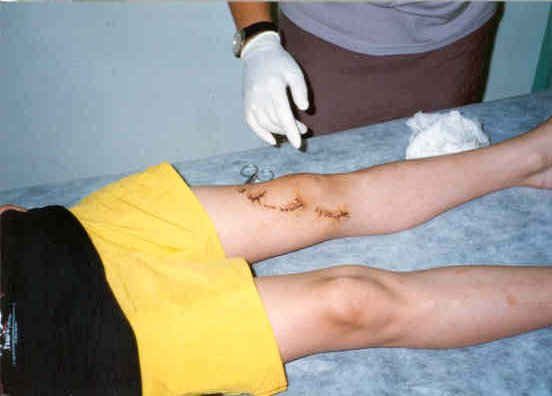
Injuries sustained following fall through unmarked plate glass window |
|
|
|